


Papastavrou in Washington: The Vertical Corridor is an ‘artery of peace and prosperity’ for European energy security
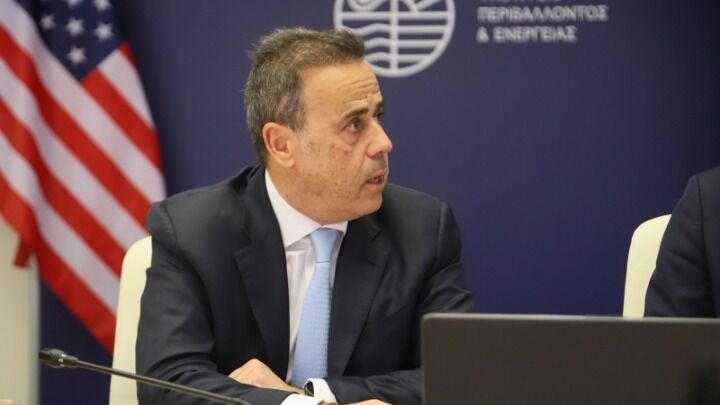
Greece’s role as an emerging energy hub in Southeastern Europe and the strategic importance of the Vertical Corridor for Europe’s energy security were highlighted by the Minister of Environment and Energy, Stavros Papastavrou, speaking at the “10 years of US-EU LNG cooperation”, as part of his visit to Washington.
In his speech at the event on Monday, Papastavrou directly linked energy policy to geopolitical stability, emphasising that the diversification of energy sources is now a strategic imperative for Europe, especially after the energy crisis caused by the Russian invasion of Ukraine.
As he noted, Greece took a clear position in favour of Ukraine from the very beginning, emphasising that the Greek stance is also linked to the country’s own historical experiences. “ Greece understood this from the very beginning and took a clear position in support of Ukraine. And how could it do otherwise, given the Turkish invasion and the ongoing occupation of Cyprus? We do not treat sovereignty as an abstract concept. We know what its violation means in practice. For us, security is a matter of national interest and determination. That is why our energy choices are fully aligned with our security commitments, as well as with our principles,” he said.
The Greek minister noted that the European Union is now the largest destination for US LNG exports, while describing the Vertical Corridor as an “ artery of peace and prosperity,” as it connects countries that were previously divided. As he said, Greece has been transformed from a purely consumer country into a regional gas transit hub. He stated that in 2019 the country imported approximately 6 to 7 billion cubic meters (BCM), which were consumed domestically, while in 2024 imports amounted to 17 BCM, of which 11 were directed to exports to neighbouring countries.
He made particular reference to the cooperation of the countries participating in the Vertical Corridor, noting that this is an initiative that requires the coordination of five states and an equal number of transmission system operators, characterising it as historic. According to him, the commercial route “ Route 1” can extend from Revithoussa to Kyiv, giving the project a clear geopolitical dimension.
Papastavrou also stressed that energy markets cannot be considered in isolation from the international security environment. “Gas markets in times of war are not neutral transactions, but have direct geopolitical consequences. Correcting this contradiction was and remains a strategic imperative. Diversification is no longer a matter of flexibility, it is a matter of strategic necessity.”
He also placed particular emphasis on the need to prevent the re-entry of Russian gas into the European market through alternative routes, pointing out that this constitutes a real risk to Europe’s collective strategy.
“We must remain vigilant. Russian gas must not re-enter Europe indirectly, through alternative routes that undermine our collective strategy. The United States and the European Commission must work closely, persist, and deter Turkiye and anyone else who is willing to open the ‘back door’ to Russian gas and undermine this common effort,” he emphasised.
In conclusion, Papastavrou stressed that Greece will continue to operate with “consistency, strategic discipline, and a clear sense of purpose, actively contributing to a secure, competitive, and energy-resilient Europe.”
On Tuesday, Papastavrou will participate in the “Transatlantic Summit on Natural Gas Security and the Vertical Corridor”, which will focus on security of supply and the coordination of the region’s energy networks.
amna.gr



Σχόλια Facebook