


Mitsotakis signals possible restrictions on new building development on ‘iconic’ Greek islands Mykonos and Santorini
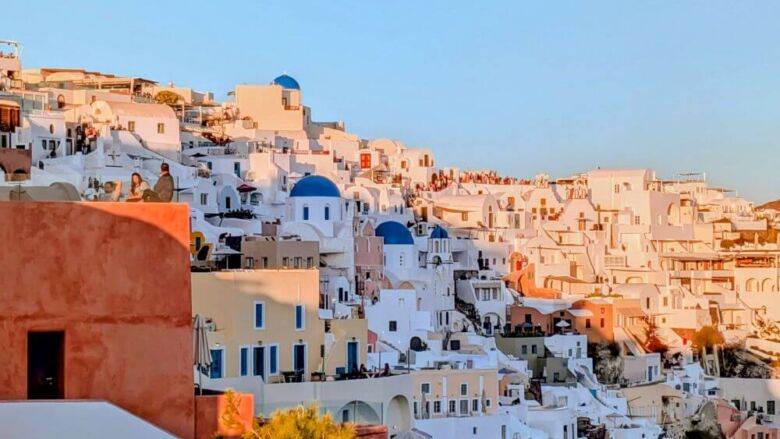
Prime Minister Kyriakos Mitsotakis on Thursday raised the possibility of imposing restrictions on new building development on islands such as Mykonos and Santorini in Greece’s new spatial planning framework for tourism.
Speaking at the Reimagine Tourism 2026 conference, organised by Kathimerini, the prime minister also announced that leisure boats would be charged for entering the planned South Cyclades Marine Park, while the government is pursuing bilateral agreements to address staffing shortages in the tourism sector.
In a discussion with Divia Thani, global editorial director of Condé Nast Traveller, Mitsotakis outlined his vision for the future of Greece’s tourism industry, including the need to protect established destinations, encourage investment in less-developed areas and extend the tourist season.
Santorini and Mykonos: protecting what already exists
Asked how he envisaged Santorini and Mykonos over the next 20 years, Mitsotakis said he did not expect “significant new development on these islands” in 20 years time.
“I think at this point the priority is to protect what we already have,” he said, warning of the danger of overdevelopment, while noting that many of Greece’s iconic destinations “are reaching the limit of what the local infrastructure can cope with, especially when we have a very significant number of people that come just in July or in August.”
He pointed out that initiatives have already been taken on Santorini to manage the arrival of cruise ships to ease pressure on the island.
“For me, in Santorini, it is much more important, rather than build another new hotel, to protect the vinyards and ensure we continue to produce this incredible wine which is associated with Santorini. We need to be aware that people will come to Santorini and spend a lot of money for this unique experience. That is not always aligned with aggressive further development,” the prime minister pointed out.
On the other hand, Mitsotakis said, Greece has islands that are completely underdeveloped in terms of their tourism infrastructure, such as the islands of Chios, Lesvos and Limnos in the northern Aegean “where you could and probably should encourage more tourism development.”
“These are incredibly beautiful islands with airports so connectivity should not be an issue. Ten years ago they were swamped by refugees and migrants, now as a result of the pilot programme we did with Turkiye we have millions of Turkish visitors who visit the islands of the eastern Aegean. So for every Santorini and Mykonos there are many more islands where you can imagine a reasonable growth strategy that still protects the environment,” he added.
He also identified considerable potential for tourism development in mainland Greece, pointing out that climate change is influencing travellers’ choices and increasing interest in mountain destinations.
Leisure boats to pay for access to the South Cyclades Marine Park
Asked about the environmental footprint of luxury tourism, Mitsotakis said that leisure boats, both large and small, would be required to pay a fee to enter the marine park being established in the South Cyclades.
He stressed that revenue generated through the charges should be reinvested in protecting the marine ecosystem.
The prime minister also underlined the importance of cooperation between the public sector and private investors in safeguarding natural environments. A large hotel complex on a very small island, he observed, could destroy its natural surroundings.
At the same time, travellers are increasingly seeking experiences that bring them into contact with nature and local communities. Such experiences can also be provided by small, family-run accommodation businesses.
He also raised the possibility of successful Greek hotel companies expanding their operations to overseas destinations.
Bilateral agreements to address staff shortages and new decree for mountain guides
Addressing labour shortages in tourism, Mitsotakis said the government was seeking bilateral agreements to facilitate the recruitment of both skilled and unskilled workers from abroad to meet the industry’s staffing needs.
He also revealed that cooperation with the private sector had begun to improve vocational training in tourism-related professions.
“Our objective should be to have the best-trained professionals and the best possible training,” he said.
The prime minister further announced that a presidential decree setting out the professional rights of mountain guides was currently being prepared.
He noted that developing activities in mountain destinations could create new employment opportunities and enable young people to work with visitors keen to discover Greece’s mountainous regions.
Golden Visa and short-term rentals in Athens
Turning to housing affordability in Athens, Mitsotakis pointed out that the minimum investment threshold for the Golden Visa programme had risen from € 250,000 to € 800,000.
He acknowledged that access to affordable rental accommodation remained a major challenge and said tax incentives were being offered to encourage property owners to switch from short-term to long-term rentals.
The aim, he explained, was to ensure that permanent residents could continue living in neighbourhoods where short-term letting was becoming increasingly widespread.
Mitsotakis also said that, in his assessment, Greece had not yet experienced a backlash against overtourism.
He highlighted Athens’ emergence as a destination in its own right, citing its cultural heritage, contemporary art scene, food and restaurant sector, as well as investment along the coastal stretch from Piraeus to Sounion.
Longer tourist seasons and higher spending per visitor
The prime minister argued that tourism success should be measured not only by visitor numbers but also by spending per visitor and the length of the tourist season.
“Our goal has been very very clear: we want to attract people who will spend more money in Greece and we don’t want them to come only during the summer months,” he said.
According to figures he presented, Greece welcomed approximately 44 million visitors last year, generating tourism revenue of € 24 billion, compared with € 4 billion in 2020, during the pandemic.
As an example of efforts to extend the season, he cited Crete, where the tourist season now runs from March to November.
The additional months, he said, increase tourism revenues while extending employment opportunities across the sector.
Greece’s cultural heritage also provides compelling reasons to visit outside the traditional summer season, Mitsotakis pointed out, noting that a visit to the Acropolis in December was better than in July or August. He said that the country wanted to encourage pensioners, particularly from Northern Europe, to spend the winter months in Greece.
Crete during the olive harvest and the Zagori villages among his recommendations
Asked where he would take a guest to give them an authentic taste of Greece, the Prime Minister chose the villages of Crete during the olive harvest and the traditional distillation season.
His second recommendation was the Zagori villages in Epirus, renowned for their traditional architecture and mountainous landscapes.
amna.gr






Σχόλια Facebook