


Greece-Cyprus electricity interconnection project to proceed in the coming period
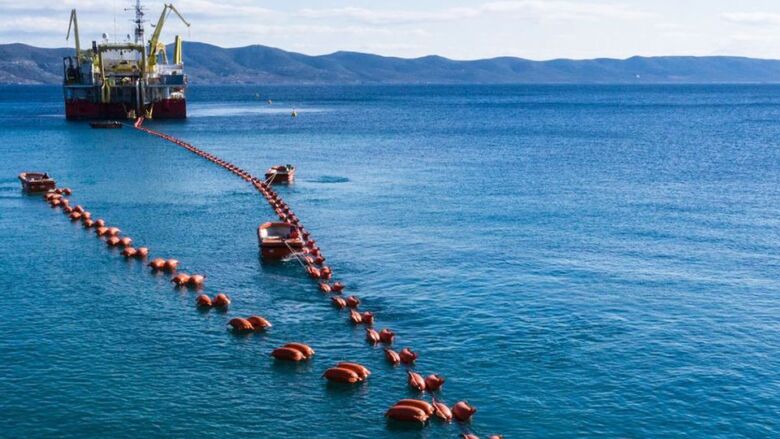
Greece, in full cooperation with France, will move forward with the Greece-Cyprus electricity interconnection project in the coming period, Foreign Minister George Gerapetritis said in an interview with Greek-American radio station Cosmos FM.
“Within the scope of its responsibilities, Greece will license the project and issue the necessary NAVTEX notices for the survey work and laying of the cable. The European Union is monitoring the progress of this project. Whatever is required on the Greek, French and European sides will be done,” he stressed.
As he noted, “there can be no question of obstructing a European project, particularly by a country that aspires to become a member of the European Union at some point. It is entirely self-evident that the rules of European law must be applied, and any concessions regarding those rules are inconceivable.”
He also recalled that the Greece-Cyprus electricity interconnection is a Project of Common European Interest and that Greece and France are not the only co-owners of the project; the EU itself is also a co-owner and is partly financing it.
The project, moreover, “ends the energy isolation of an EU member state, Cyprus. Therefore, by definition, it also strengthens the resilience of the European energy market, as well as the interconnectivity of the energy market.”
“Under international law, electricity interconnections of this kind are free and cannot be obstructed by any country,” he stressed.
Regarding Greece-Turkiye relations, he stressed that “Greece’s position is longstanding and consistent and upholds our national positions.” He noted that Greece supports diplomacy and constructive dialogue, which is why the two sides agreed in 2023 to launch a new form of structured dialogue, with pillars, timetables, accountability and responsibility.
“And indeed, over the past three years, despite tensions arising from the underlying cause, namely the lack of delimitation of the continental shelf and exclusive economic zone, we have managed to avoid major crises on the ground.”
“We remain committed to the position that channels of communication must remain open,” he said, adding that “for this to happen, both sides must remain faithful to the basic rules of the game.”
“And the basic rules of the game are none other than the shared conviction that international law must be universally applied. It goes without saying that faits accomplis cannot be tolerated and that our national positions must be respected. Turkiye is obviously a powerful country in the wider region. This does not alter the fact that any differences between us must be resolved on the basis of rules and not on the basis of a projection of power.”
“Over the past three years, during which we have set in motion a functional relationship with Turkiye, Greece’s position in the world has developed remarkably. Greece is now an exceptionally strong country on the international stage,” he stressed.
He underlined that “dialogue with Turkiye is necessary”, since “geography is a given”. “On the other hand, both sides must commit not only to maintaining a moderate tone, but also to being absolutely firm on the ground when it comes to the application of international law. International law either applies universally or it does not exist.”
‘Greece at the forefront of global diplomacy’
The Foreign Minister noted that, at this very critical juncture, amid multiple armed conflicts, “Greece is at the forefront of global diplomacy.”
“We are an elected member of the Security Council and are assuming the presidency at the most complex of times. This is because, beyond the crises we will be called upon to manage, there are a number of key issues that the Greek presidency has chosen to put forward, such as freedom of navigation and the protection of women and children in armed conflicts.”
He noted, Greece is preparing for its presidency of the Council of the European Union in the second half of 2027. “Therefore, the responsibilities and duties of Greek diplomacy are multiple.”
He stressed that it was important for Greece to capitalise on its presence on the Security Council. “At this moment, multilateralism and international law are in decline. The law of the strongest appears to be prevailing. Greece, from the position it has been assigned on the world stage, has a very strong voice of its own, while we also give voice to countries that are not currently represented on the Security Council.”
“Our voice is amplified when we uphold the established principles of international law and the authority of international organisations, in the face of unilateral actions that create adverse faits accomplis and alter the status quo for the worse.”
He noted that Greece is assuming the presidency of the Security Council at a very critical moment for the global security architecture. Actions concerning the management of the major ongoing conflicts in Ukraine, the wider Middle East and Africa will have a primary role. However, he added, “we will also be responsible for important developments currently taking place around the world, such as the situation in Haiti, Western Sahara, Colombia and elsewhere.”
The presidency will also play an extremely important role in the process of selecting the new Secretary-General. “For us, it is very important that there should be a Secretary-General who has the standing and the determination to pursue major reforms, strengthen multilateralism, help consolidate the rules of international law over the exercise of power, and attach primary importance-as Secretary-General Guterres has done-to the Cyprus issue and its resolution on the basis of United Nations Security Council resolutions.”
amna.gr






Σχόλια Facebook