


Rubio and Gerapetritis stress importance of U.S.-Greece alliance; Greece a ‘true and strong and model ally’, Rubio says
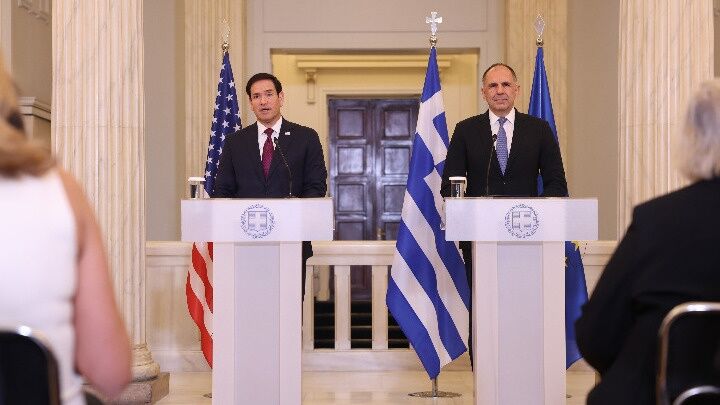
Greece and the United States have agreed to sign a new memorandum for the exchange of information, for deeper energy cooperation, to expand the supply of U.S. LNG and boost the defence partnerships within NATO, Greek Foreign Minister George Gerapetritis and U.S. Secretary of State Marco Rubio announced in joint statements after their meeting in Athens on Wednesday for the 6th U.S.-Greek Strategic Dialogue.
In his remarks, Gerapetritis said that, amid intensifying competition, the Strategic Dialogue with the United States is a constant that reflects the high level of their relations and promotes international and regional stability and security.
He added that the Vertical Corridor is the backbone of the transportation of U.S. LNG to Europe, while the Greek-owned fleet carries one quarter of U.S. LNG.
The minister went on to say that Souda and Alexandroupolis highlight the strategic presence of the United States in the region. At the same time, the deployment of F-16 Vipers and the integration of F-35 fighter jets demonstrate the steady defence cooperation between the two countries and strengthen Greece’s defence capabilities.
“The Greek diaspora is a driving force in deepening Greek-U.S. relations,” Gerapetritis stressed, noting that there are currently more than 100,000 US citizens of Greek descent live in the United States and more than 100 direct flights between the two countries, adding: “We discussed the Middle East, Ukraine and the situation in sub-Saharan Africa, which also affects migration flows. Greece attaches particular importance to the security and freedom of navigation, an issue it highlighted during its presidency in 2025.”
Gerapetritis also said that the security of Christian populations is a priority, with Greece remaining in constant contact with the ancient Patriarchates of the Middle East, as is the fight against outdated nationalism in the Balkans.
Greece is consistently maintaining its defence spending above the prescribed threshold, Gerapetritis stressed, adding that it is a provider of security, maintaining a leading role in all naval operations, such as ASPIDES and ATALANTA, which complement U.S. initiatives.
It also plays a critical role in multilateral frameworks such as 3+1, which has been upgraded into a very strong geopolitical, multilateral framework, partly thanks to Rubio’s contribution.
Referring to Cyprus, he stressed that it is an essential part of the security architecture, noting that its reunification is necessary, guided by international law, in order to restore peace and prosperity and consistently deter any revisionist threat.
Finally, the Greek foreign minister said that the bond between Greece and the United States is based on shared values, in the wake of the revolutions in the two countries. “As Thomas Jefferson wrote in his reply to Adamantios Korais during the Greek War of Independence: ‘No people feels a livelier sympathy than we do for the sufferings endured by the Greeks,’” he concluded.
Rubio, on his part, stressed that the U.S. and Greece “share a long history of friendship and alliance,” adding that the “importance of this historic alliance is highlighted by the instability in the world today,” citing the turmoil in Iran, the Strait of Hormuz, Yemen and Ukraine.
“As you see a world that faces these destabilising events, you recognise how important this alliance with Greece is to the United States. It is both historical in its foundation but it is also critical, it is a source of stability in an unstable world. This is an alliance of historic character with strong foundations, which is a source of stability,” he said.
Rubio said the United States was “grateful that Greece is a great ally,” and noted that the two countries share a “common understanding about the about the threats that face our countries and societies and a common understanding on the means with which to address them.”
He also highlighted the fact that Greece was on track to meet commitments to spend 5% of GDP on defence and was already spending 3.5% of GDP on core defence, while commenting that “the nations of Europe need to take on a greater share of the burden in defending their continent and Greece is doing just that.”
The U.S. Secretary of State also said that Greece is a close partner in combating mass migration, criminal organisations and in counter-terrorism. Because of its geographical position, he noted, it is particularly exposed to threats posed by mass migration, human trafficking and various forms of terror.
He went on to announce a new memorandum of understanding “establishing a joint security programme, to strengthen counter-terrorism information sharing between our respective law enforcement agencies,” adding: “We do not want under any circumstances to see the birthplace of the West is threatened by bad decisions, by inaction, by failure to address challenges. So this programme is going to create stronger, more proactive, law enforcement that can readily stop these threats.”
All of these initiatives, Rubio stressed, show that Greece is a true and strong and model NATO ally, a country that understands the importance of burden-sharing and this willing to act with partners to address critical threats to all member-states.
Rubio then went on to stress that Greece is also an important partner in securing the Alliance’s economic future also, as it plays a vital role in global commerce in a variety of ways and in a variety of industries.
He listed the two countries intent to deepen collaboration on emerging technologies, expand LNG imports and build new gas and electricity interconnectors that strengthen regional energy security.
Finally, he added, the two countries are working together to combat antiquities trafficking into the United States, which finances criminal organisation and harms the U.S. art market. He said that the State Department and its partners in Homeland Security, the FBI and other U.S. organisations were cooperating with Greek law enforcement to safeguard cultural property across the Mediterranean, “to protect our shared cultural heritage from illicit trafficking,” he said.
Photo: ANA-MPA/GIORGOS VITSARAS
amna.gr






Σχόλια Facebook