


PM Mitsotakis at Daedalus supercomputer inauguration: We are investing in the future
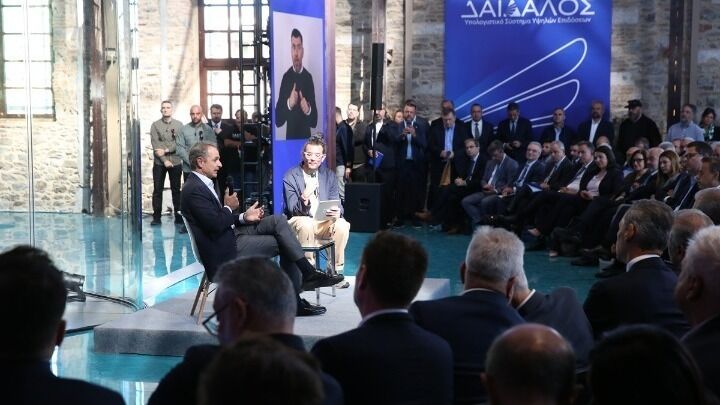
Prime Minister Kyriakos Mitsotakis on Monday stressed the importance of investing in infrastructure that will lay the foundations for the future during the inauguration ceremony of the Daedalus supercomputer in the coastal town of Lavrio, Attica.
“We often hear voices who only seem to want to spend money we do not have,” the prime minister said, noting that they failed to consider “how important it is to invest in the future.”
Mitsotakis cited the example of Themistocles and the decision taken by the ancient Athenians on how to use the wealth generated by silver mining. When the question arose as to whether the money should be distributed among the citizens of Athens or invested, Themistocles proposed using it to build triremes.
“They invested it in defence, and we all know how the course of world history subsequently changed as a result of that choice,” he said, linking the example to the importance of investing in infrastructure that Greece will need in the years ahead.
Referring to Daedalus, he noted that while the significance of such an investment might not be immediately apparent to everyone today, it represented “the infrastructure that will take us on to the highways of the future”.
Lacking such infrastructure, he added, Greece would be unable to make the leaps forward it aspires to achieve.
The prime minister traced Greece’s journey from “laggard to leader” in digital technology, from the launch of the gov.gr digital public services portal in 2019 to the investment in high-performance computing. He stressed that developing domestic infrastructure would reduce reliance on foreign providers and allow Greece to build its own AI applications rather than simply consume services developed elsewhere.
Mitsotakis highlighted opportunities for citizens to interact with gov.gr through AI-powered applications, while small and medium-sized businesses and researchers could use Daedalus to develop new products and undertake complex research projects. He argued that Greece’s competitive advantage lay not in competing with major international technology companies to build the most advanced AI models, but in developing practical applications with tangible economic benefits.
“The game for Greece will mainly be played in applications,” he said, encouraging start-ups, businesses and researchers from Greece and abroad to take advantage of the new infrastructure. He also pointed to the potential of AI in civil protection, including the early detection of possible wildfires and the development of models to predict how fires spread.
Mitsotakis acknowledged the need to address the technology’s potential negative consequences, saying countries that successfully harness its capabilities while managing its risks would lead in the years ahead.
Technical specifications
Daedalus has a measured computing performance of 85.69 petaflops, ranking 31st globally in the TOP500 list and 23rd in the Green500 energy-efficiency ranking, according to the June 2026 rankings. It is the most powerful computing system recorded in Greece to date.
The system is based on Hewlett Packard Enterprise architecture and uses NVIDIA GH200 accelerators, combining central processing units (CPUs) with graphics processing units (GPUs). Direct liquid cooling technology helps manage heat and energy consumption.
Its storage infrastructure includes a 1-petabyte high-performance NVMe system and 10 petabytes of total usable storage capacity. The system is designed to support scientific research, large-scale data processing and the development and training of AI systems, serving users across academia, research, business and the public sector.
The project forms part of a wider European effort to expand high-performance computing infrastructure and strengthen research, innovation and competitiveness.
Papastergiou highlights technological sovereignty
The digital governance minister described Daedalus as a strategic investment in Greece’s technological autonomy, saying the country had become the 14th worldwide to acquire comparable infrastructure.
He said the supercomputer would give Greece greater control over its data and computing resources, enabling it to develop domestic AI applications using Greek talent and data held in Greece and Europe.
Following Monday’s activation, testing and technical adjustments will take place, with the first services expected to become available in December. The infrastructure is intended to support Greek universities and research centres, strengthen business activity and create opportunities to retain highly skilled professionals in the country.
Papastergiou also highlighted potential cooperation with Cyprus, Malta, Serbia and North Macedonia, saying advanced computing infrastructure could reinforce Greece’s role in the wider region.
Installed in the historic former power station at the Lavrio Technological and Cultural Park, operated by the National Technical University of Athens, Daedalus occupies a site once used to generate electricity. Its architectural design draws inspiration from an ancient Greek trireme, symbolising the transition from the industrial age to a new technological era.
amna.gr








Σχόλια Facebook