


At 96 Years of Age, She Became a Greek Citizen
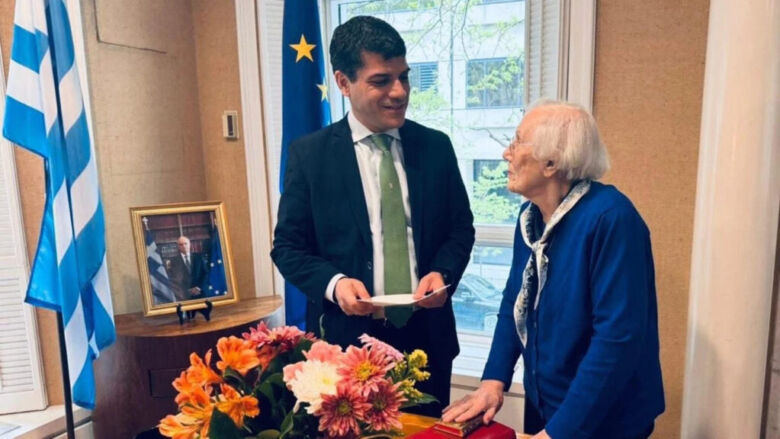
A petite woman, with white hair and a steady gaze, slowly rose from her chair. Beside her stood members of her family. Opposite her were the consular authorities. When she raised her right hand to take the oath of naturalisation, a circle was being closed that had opened more than a century earlier, when her parents had left Greece in search of a better life on the other side of the Atlantic. Everyone in the hall of the Consulate General of Greece in Chicago knew that it was a historic moment.
Mrs Charikleia (Harriet) Voulgaris-Antonak officially became a Greek citizen at the age of 96, deciding to bring a sweet conclusion to a personal journey of identity and memory. Today, she is the oldest member of the Greek diaspora to have completed the naturalisation process through the Greek state. Her story, however, touches many others as well. It concerns millions of people of the Greek diaspora who continue to carry Greece within them, even though entire generations have passed since their ancestors arrived in their new homeland.
“I did it mainly for my grandchildren,” she told Kathimerini from her home in Chicago, Illinois. “I thought that perhaps one day they too might wish to acquire Greek citizenship. My parents left Greece so many years ago, and it was very difficult to locate the necessary documents. But they were found. I wanted to give them that opportunity. That was the main reason I persevered and waited all these years.”
THE GREAT JOURNEY
The story of her family begins at the beginning of the last century. Her father, Gus (Kostas) Antonakos, left Cephalonia at the age of only seventeen. Her mother left her village, just outside Sparta, a few years later, around 1922. They belonged to the great generation of Greek immigrants who left the country in the early twentieth century in search of work and opportunities in an America that then seemed like the Promised Land.
From 1890 through the 1920s, more than 400,000 Greeks emigrated to the United States. Many were young men from rural areas of the Peloponnese, Central Greece, and the islands. Others followed relatives who had already settled there. Most arrived with very little money in their pockets and the hope that they could build a life that had not been possible in their homeland. Mrs Antonak’s father was no exception.
“He took whatever work he could find. He once told me that at one point he was breaking stones just to earn a living,” she recalls. “Later, he managed to acquire businesses and restaurants.” His story resembles that of thousands of Greek immigrants who started from very humble beginnings and gradually established small businesses, restaurants, and shops, building the Greek communities that still exist today.
GREEK CHICAGO
The family eventually settled in Chicago. For many decades, the city became one of the most important centres of Hellenism outside Greece. The famous Greektown became a point of reference for generations of immigrants, a place where they could speak their language, find employment, establish businesses, and preserve their traditions. Mrs Antonak’s father opened the restaurant Seven Seas there. It was not exclusively a Greek restaurant, as she explains, but it was part of a vibrant Greek neighbourhood alive with celebrations of national holidays.
“The Greek community of Chicago is one of the most vibrant and dynamic communities of the diaspora,” agrees the Consul General of Greece in Chicago, Mr Emmanuel Koubarakis. “The presence of Greeks in the region spans more than a century and has left a strong imprint on the economic, social, and cultural life of the city,” he told Kathimerini. Today, dozens of parishes, schools, cultural associations, and organisations continue to keep the Greek presence alive. At the same time, Greek Americans have distinguished themselves in politics, academia, business, and the sciences, making them one of the most successful immigrant communities in the United States.
FROM GENERATION TO GENERATION
Mrs Antonak belongs to the second generation of Greek Americans. She does not speak Greek, apart from a few basic words. Nevertheless, Greece never left her home.
“Every year we gather for Greek Easter. We try to prepare Greek dishes—pastitsio, dolmadakia—and to keep our traditions alive,” she says.
Her children, she recounts, continue to visit Greece with their Greek passports and meet relatives who never left the country. “There is still a very close connection,” she says. “My children still see my cousins’ children whenever they travel to Greece.” She herself visited the country several times during her lifetime. She travelled to Cephalonia, Sparta, Athens, and other places, following the traces of her family’s history. Her last visit took place about twenty years ago, together with her husband, as she recalls while reminiscing about the past.
Beyond the many emotions it evokes, a Greek passport also carries considerable practical value. It provides all the rights that accompany citizenship of the European Union: free movement, study, employment, and residence in any member state. For younger Greek Americans, these opportunities often serve as an additional incentive for acquiring Greek citizenship.
“It is not simply about obtaining a passport,” stresses Consul General Koubarakis. “It is often a deeper search for identity, family memory, and cultural heritage.” “Greece and the United States both allow dual citizenship, which facilitates this connection. For many Greek Americans, it is not a matter of choosing between two homelands. It is a way of honouring both sides of their identity.”
A COMPLEX PROCESS
Although Greece follows the principle of jus sanguinis—the transmission of citizenship through descent—proving that descent can be complex, particularly for families who left the country a century ago. Birth certificates, family records, civil registry documents, and historical archives often have to be traced in small villages and communities throughout Greece. In many cases, the process can take years.
The Consul General points out that the authorities’ goal is not to exclude applicants. “At the Consulate General, we strive every day to help members of the diaspora navigate and proceed through this process in the best possible way,” he emphasises. “Behind every application,” he says, “there is a family story. Behind every file there are not simply documents, but family histories that have connected people with Greece for generations.”
In the case of Mrs Antonak, “it is not only her age that is impressive, but above all her perseverance, determination, and enduring love for Greece.”
She continually returns to her grandchildren when explaining her decision.
“I want them to preserve their roots, to return to them, and always to have a second home,” she says, expressing her heartfelt wish, “even if I myself never travel there again with my Greek passport.”
Source: Kathimerini.gr / Nina Maria Paschalidou






Σχόλια Facebook