


A Call to the Hellenic American Community: July 9, 1776–2026
By:Lou Katsos President, EMBCA
On that day, General George Washington ordered the Declaration to be read aloud to the Continental Army and assembled citizens at the Commons, adjacent to what is now City Hall Park.
This was no mere ceremony. It was one of the defining moments in American history.
As the largest British military expedition ever sent to North America gathered in New York Harbor, Washington’s army stood poorly equipped, vastly outnumbered, and facing an uncertain future. The fate of the Revolution—and perhaps the very idea of American independence—hung in the balance.
Yet it was at that very moment that the Declaration was proclaimed.
With those words, the conflict ceased to be a dispute between the colonies and the British Crown. It became an irrevocable commitment to liberty, self-government, and independence. For the soldiers listening that afternoon, there could be no turning back.
The response was immediate.
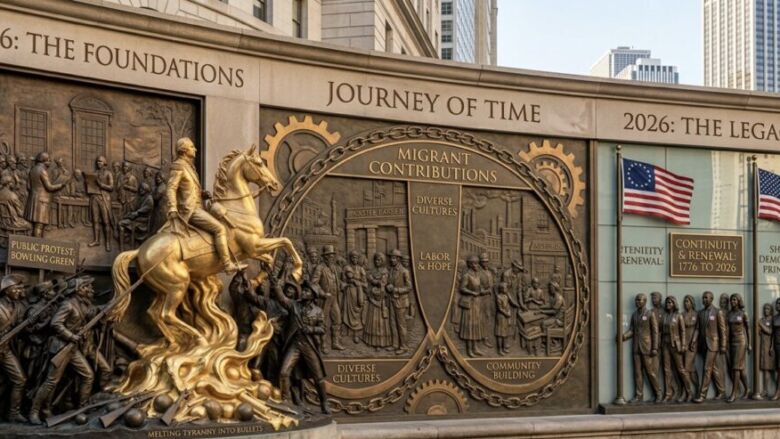
Soldiers and citizens marched down Broadway to Bowling Green, where they toppled the equestrian statue of King George III, the most powerful symbol of British authority in the colonies. Its lead was later melted into more than 42,000 musket balls for Washington’s army—a striking transformation of imperial power into the ammunition used to defend American independence.
That march from the Commons to Bowling Green was more than an act of protest. It was one of the first great public demonstrations of the American Revolution, affirming that the ideals of the Declaration belonged not only to Congress, but to the American people themselves.
For that reason, July 9 deserves far greater recognition in the story of America’s founding. While July 4 marks the adoption of the Declaration, July 9 marks one of its earliest and most powerful public affirmations. It was the day New York openly embraced independence despite overwhelming military danger.
History remembers Washington’s victories, but July 9 reminds us of something even more profound.
He stood before his soldiers not in triumph, but amid uncertainty. Within weeks, British forces would land on Staten Island and Long Island. Within months, New York would fall, and Washington would be forced into one of the most difficult retreats in military history.
Yet the principles proclaimed that afternoon survived the loss of the city. They outlasted defeat, occupation, and hardship, ultimately giving birth to the United States.
That is why July 9 stands among the pivotal moments of the American Revolution. Nations are not founded by documents alone, but by the courage of those willing to proclaim, defend, and sacrifice for the ideals they contain.
On Thursday, July 9, 2026, at 6:00 P.M., New Yorkers will once again retrace that historic journey from City Hall Park to Bowling Green, commemorating the public reading of the Declaration as America begins celebrating the 250th Anniversary of its founding.
For the first time, the original 13-star American flag, representing the birth of the Republic, will be raised alongside today’s American flag at Bowling Green, creating a powerful visual link between America’s founding generation and nearly two and a half centuries of national history.
The symbolism is even greater because one of these flagpoles marks the 30th anniversary of its installation by the Federation of Hellenic Societies of Greater New York. For three decades, these flagpoles have served not only as the site where the American and Hellenic flags are raised together during New York’s annual Greek Independence Day celebrations, but also as a place where the flags of many nations have honored the immigrant communities whose contributions have enriched the civic, cultural, and economic life of New York and the United States.
Together, the two American flags will symbolize both continuity and renewal—a nation founded upon enduring ideals and strengthened by successive generations who embraced them.
For Hellenic Americans, this commemoration holds particular meaning.

The principles of liberty, democracy, civic responsibility, and self-government proclaimed in 1776 have deep roots in the political thought of ancient Hellas. America’s Founding Fathers drew inspiration from Hellenic history and philosophy, while a generation later Americans responded with extraordinary Philhellenic support for Greece’s own War of Independence during the era remembered as “Greek Fever.”
As heirs to both traditions, Hellenic Americans occupy a unique place within the American story. We are inheritors of two of history’s greatest democratic legacies and share a responsibility to preserve both.
Having had the privilege of working with the organizers of this annual commemoration, I have come to appreciate even more the national importance of July 9 and the dedication of those ensuring this pivotal chapter of American history receives the recognition it deserves as our nation approaches its Semiquincentennial.
For that reason, I respectfully encourage the newly united Federation of Hellenic Societies of Greater New York, together with its newly elected Officers and Board of Directors, to make participation in this commemoration one of its first public acts as a unified organization.
I likewise encourage our churches, professional Hellenic organizations, student associations, cultural and fraternal societies, veterans’ organizations, philanthropic institutions, and Hellenic American families throughout the metropolitan area to participate in this historic reenactment.
Our presence should reflect more than pride in our Hellenic heritage. It should affirm our enduring commitment to the American ideals that have enabled generations of Hellenes to flourish while contributing to the civic, educational, military, scientific, business, and cultural life of this nation.
There could be no more fitting way to honor both America and Hellas than by walking together along the very streets where New Yorkers first publicly embraced American independence nearly 250 years ago.
As America approaches its 250th Anniversary, July 9 offers more than an opportunity to remember history. It calls upon us to reaffirm the enduring principles of liberty, democracy, self-government, civic responsibility, equality before the law, and the courage to defend them when they are tested.
On July 9, 2026, let us gather at City Hall Park and walk together to Bowling Green, retracing the footsteps of those who transformed the Declaration of Independence from words on parchment into the public resolve of a nation.
Let us honor not only the birth of the United States, but also the timeless ideals that unite our Hellenic heritage with our American identity.
From the Commons to Bowling Green. From 1776 to 2026.
History is not preserved by anniversaries alone. It is preserved by those who choose to participate.
Let the Hellenic American community answer that call—together.
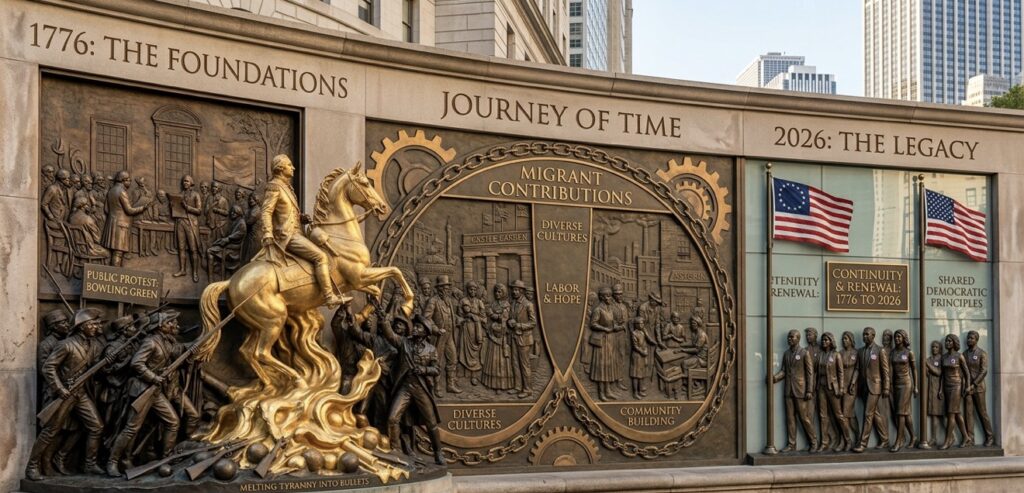
Most Americans recognize July 4, 1776, when the Declaration of Independence was adopted in Philadelphia. Far fewer know that July 9, 1776 was the day those revolutionary words were first publicly proclaimed in New York, transforming a written declaration into a living national cause.
Source: https://www.hellenicdailynewsny.com
Link: https://www.hellenicdailynewsny.com/en-us/diaspora/a-call-to-the-hellenic-american-community-july-9-1776-2026







Σχόλια Facebook