


PM Mitsotakis at Trilateral Summit in Egypt: A shared vision for stability and prosperity
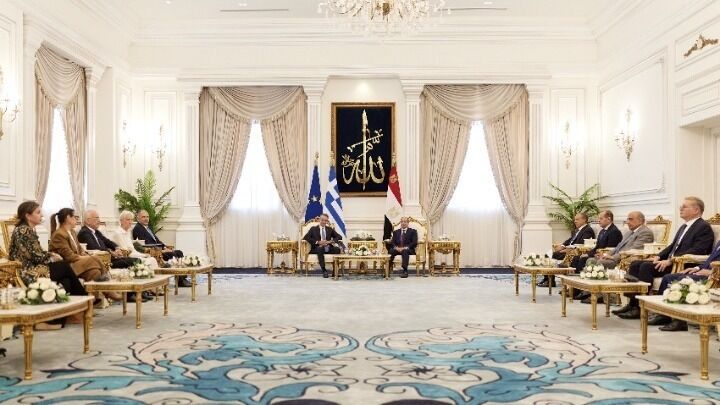
Speaking during the joint statements made by the leaders of Greece, Cyprus and Egypt following their informal trilateral summit, Prime Minister Kyriakos Mitsotakis pointed out that they held extensive discussions on all major regional challenges. This, he said, proved that this cooperation served as a positive paradigm for stability and security – a path of understanding that always advances a positive agenda and is directed against no country whatsoever.
“Regarding Gaza, we reiterated our support for a just peace, consistently based on the two-state solution,” he noted, highlighting the need for humanitarian aid to arrive unhindered and for Hamas to be disarmed.
“We must curb illegal migrant flows from eastern Libya to Greece, and I would like to congratulate President El-Sisi on the determination shown by Egypt, in managing and tackling the problem of illegal migration,” Mitsotakis stated, referring to Egyptian leader Abdel Fattah El-Sisi.
Concerning the Cyprus issue, he stated that he reiterated his solidarity regarding the prospect of a fair and viable settlement within the framework of the United Nations and in accordance with Security Council resolutions. “This would constitute a significant contribution to peace and stability throughout the Eastern Mediterranean. We support efforts for the resumption of talks,” he underlined.
Regarding freedom of navigation, Mitsotakis stressed that it is a matter of global importance. “A global maritime power, such as Greece, places this issue at absolute priority. The Greek presidency of the Security Council is planning new initiatives,” he added. As the Greek premier also emphasised, “We are united by our commitment to international law, specifically the Law of the Sea, having proved in practice that the delimitation of maritime zones can be achieved through dialogue,” referring to the partial agreement with Egypt, “which demonstrated that when there is political will and a commitment to international legality, we can achieve mutually beneficial convergences while simultaneously enhancing stability in the region.”
“This has been, is, and will continue to be our overall approach both in the Eastern Mediterranean and the Aegean. Greece threatens no one; it seeks stability through functional, good-neighbourly relations, always grounded in international law. However, stability by no means implies yielding or tolerance towards accomplished facts. Consequently, Greece is afraid neither to defend its positions with confidence nor to engage in dialogue. These are the two sides of a responsible foreign policy,” the Greek PM declared.
The prime minister referred to the cooperation among the three countries in the fields of energy, connectivity and investments, describing the Greece-Egypt electrical interconnection as a project of strategic significance.
El-Sisi: Trilateral cooperation enhancing stability region; Egypt-Greece electricity connection ‘a true milestone’
The strategic importance of the cooperation between Egypt, Greece and Cyprus for stability and security in the Eastern Mediterranean was underlined by President of the Arab Republic of Egypt Abdel Fattah El-Sisi, following the conclusion of the meeting.
The Egyptian president placed particular emphasis on the energy connection with Greece, cooperation in the natural gas sector, and the coordination of third countries on issues of defence and security. He also described the Trilateral mechanism as a model of strategic regional cooperation, underlining that it is based on mutual respect, mutual benefit and the defence of International Law rules. El-Sisi also referred to the three countries’ shared commitment to strengthening stability in the region, but stressed that security should be based on respect for countries’ sovereignty and of International Law.
On energy cooperation specifically, the Egyptian president said it was at the forefront of the Trilateral relationship. Egypt, he said, placed great significance in the promotion of power connectivity works, especially that of Egypt and Greece, which he described as “a true milestone” in advancing regional energy integration. He also referred to plans for the transfer of Cypriot natural gas to Egyptian infrastructure and then to its re-export to European countries.
El-Sisi also made a particular note of the Trilateral scheme’s defence aspect, as cooperation between the three countries included coordination in security and defence sectors in order to manage challenges in the region. In addition, the three countries reviewed ways of further boosting political coordination and economic cooperation, as well as new investment capabilities in Egypt in the sectors of technology, infomatics, tourism, industry, health, education, construction and infrastructure.
Commenting on developments in Gaza, he expressed Cairo’s opposition to any effort to “displace Palestinians” or “change the demographic composition of Palestinian lands”. He called for the full implementation of the Sharm el-Sheikh ceasefire agreement and for the unhindered access of humanitarian aid. El-Sisi also reiterated Egypt’s position in favour of an independent Palestinian state within the borders of June 4, 1967, with East Jerusalem as its capital.
On other issues, El-Sisi stressed the importance of a Libyan-led political process that would lead to the holding of elections, while calling for the withdrawal of all foreign forces, foreign fighters and mercenaries from the country. Regarding Syria, he highlighted the convergence of the positions of Egypt, Greece and Cyprus in favour of preserving the country’s unity and territorial integrity and opposing any attempt to partition it.
The three leaders also exchanged views on developments in Sudan and the Horn of Africa, with El-Sisi reiterating Cairo’s overall position in favour of de-escalation and the pursuit of political solutions to the crises affecting the wider region.
Christodoulides at Trilateral meeting: We have built a stable framework that continues to grow stronger
President of the Republic of Cyprus Nikos Christodoulides stressed that since 2014 they had built a stable framework that has continued to strengthen.
“It now has strategic depth and is based on a positive approach: stability, security, connectivity and cooperation,” he said.
The Cypriot president stressed that cooperation between the three countries was deepening and expanding at many levels.
“We had the opportunity to exchange views on the latest developments in the region. Our countries are seeking a peaceful and stable Eastern Mediterranean and wider Middle East, characterised by good-neighbourly relations and respect for international law,” he underlined.
Christodoulides said that the Joint Declaration adopted today underscored these objectives. Regarding the Palestinian issue, he said they had reaffirmed their longstanding position in favour of a two-state solution. With regard to Gaza, he stressed that Egypt was playing a pivotal role, while Cyprus was stepping up humanitarian assistance. As for Lebanon, he said that support for the country from the three leaders remained strong.
“Cyprus, Greece and Egypt consider freedom of navigation to be a priority, in accordance with international law. Egypt is a key pillar of security and stability in the wider region. Egypt’s security and stability are inextricably linked to the stability and security of all the states in the region and, of course, of Europe. We are working towards further EU support for the country. Egypt’s strategic importance is understood in Brussels. We welcome the release of the next tranche of financial assistance to Egypt,” he continued.
The president of the Republic of Cyprus described President El-Sisi’s participation in the first informal summit, held in Nicosia, as historic. “Let me conclude by thanking Egypt for its steadfast and longstanding support for efforts to reunify our homeland on the basis of United Nations resolutions,” Christodoulides said in closing.
amna.gr






Σχόλια Facebook